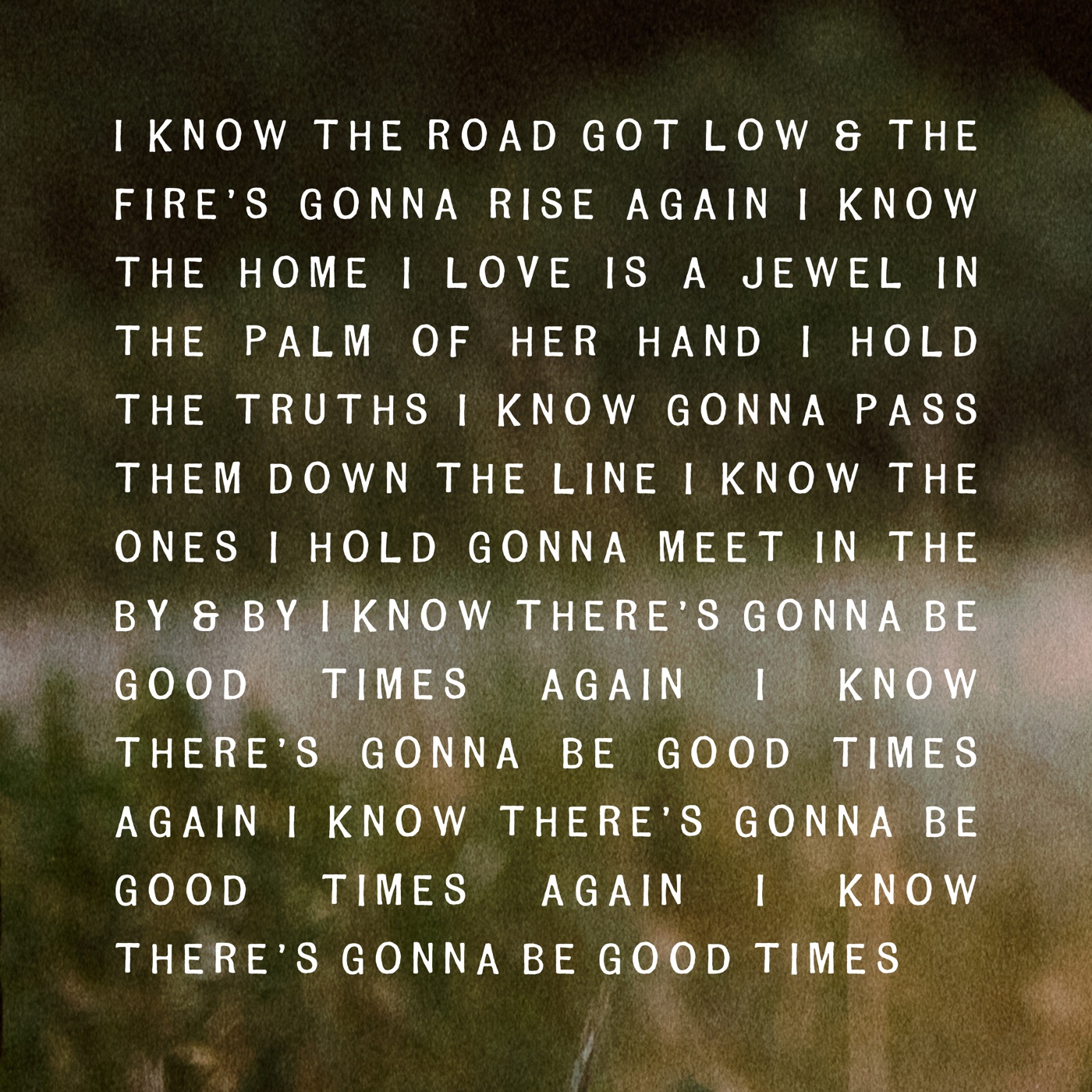
I Know There's Gonna Be Good Times Again
a new old time song
featuring Singing The Bones, The Good Dream, and Leah Song & Chloe Smith of Rising Appalachia
out now · Specific Records
About This Song
This tune came to me two years ago, in a single week when three big things happened in my life.
First, I went into San Quentin Prison for the first time with Alive Inside, an organization that brings music and grief work to incarcerated communities. Playing music in prisons had been a lifelong dream of mine, and finally meeting the men in there — folks society had cast out and deemed disposable or irretrievably unsafe — was a profound and life-changing experience. What surprised me most, among all the other emotions, was how uplifted I felt coming into contact with the depth of the humanity happening inside: the feeling, the grief, the gratitude, the creativity and talent, the hope. I wanted to write something that would tell these guys how I feel without saying it straight on. This tune I guess was how I needed to do that.
Second, I had just moved in with my girlfriend (now fiancé), and we got into a dumb little fight where I saw myself with a clarity I’d never had before. I saw how much work I still have to do to become the man I’m capable of being, saw how clinging to old patterns and old stories was holding me back and causing pain to everyone around me, and saw how great it would be if I could become that guy kinda soon. And this filled me with hope.
Third, I held a dear friend as she cried and cried after getting played by a man who promised her the world and then just reenacted a painful pattern of rejection that had thumped her over and over already in her life. We’re bandmates, so we played music together, and wove into it a spell for the love that’s coming for her.
In the midst of all of this, I sat down in my studio in West Oakland to play fiddle and clear my mind, and this tune fell into my lap. Hard to say how that happened. I was just playing aimlessly, and then somehow I was playing this. As it emerged, I felt the familiar impulse to “straighten it out,” and something inside me said: wait. Don’t do that. And I’m so glad I didn’t, because this tune is squarely in that Old-Time tradition: cross-tuned, down-tuned, and crooked as hell.
Cross-tuned & Crooked
Tuning. “Good Times” is in a relatively obscure alternative fiddle tuning called “calico,” where the strings are retuned to sound a major chord — traditionally A-E-A-C♯, but here two whole steps lower: F-C-F-A. On top of that, the fifth string of my five-string fiddle is tuned down to B♭, creating a ringing IV chord at the bottom of the instrument that all the verses arrive into, like settling into a home away from home, over and over.
Timing. “Good Times” is probably in a meter of ten, although opinions differ among my collaborators. This, too, is part of the Old-Time tradition — tunes whose underlying heartbeats stay constant but who seem to wiggle around on top of that, appearing simple while defying expectation and explanation. According to Kele Nitoto, my bandmate in Singing The Bones who plays djembe on this recording, the A part (verse) is in 10/4, while the B part (chorus) is a bar of 4/4, a bar of 3/8, a bar of 5/8, and a bar of 2/4. But Kele also says he’s not sure, and just feel it, man.
Lyrics. The words took about six months to arrive, but lyrics are always slow like that for me. I knew the name of the tune the day I wrote it, which is the one line in the chorus. I wish there were a cooler story for how the rest of it came to be, but the truth is I was just driving in my truck one day, listening to a voice memo of myself playing the tune, and the song fell out of me.
Production
I’ve been refining this sound for about two years now, with a small batch of tunes baked this same way — multi-tracked string captures, heavy bass, many layers of found samples and acoustic percussion woven in. This whole album was recorded in my cabin in Oregon, a straw bale & earth plaster room in the Illinois River Valley, so a lot of the percussion samples and ambient layers are recorded right here in the woods. I’m trying something different with the fiddle sound, giving it more room in the low mids than I usually hear this instrument placed, to invite it a little deeper into the body — and exciting, saturating, and in some cases even degrading the highs to bring out the dust and scratch of the bow. I want to present the fiddle as a centerpiece, not a background instrument waiting for a “real” voice to step in front. I also want to offer it the way I hear it under my ear: imperfectly, with the hide and the hair still on it, in an homage to the scratchy old field recordings of the Old-Time canon. I suspect that in a certain light, we can find this scratchiness beautiful, like the rasp in a voice. I’m trying to create the conditions for that light. I’m also trying to build a low end that can shake your car. We contain multitudes.
Fiddle music makes me want to move as intensely as the heaviest club banger, and it feels deeply right to me to slow it down, warp it out, and sneak a couple of 808s underneath. My goal has always been to weave these worlds together with integrity and respect, honoring my roots in this culture while expressing the full breadth of my love for music in all her many forms. One of the ways I did that on this record was by turning off quantization, and allowing the tunes to flex and breathe the way they do when we play them. This meant that even when I was placing samples and drawing in synths, I couldn't copy/paste — each sound on this record was dropped, nudged, and faded by hand.
The Features
Singing The Bones. My bandmates Lydia Violet — a singer and a keeper of Joanna Macy’s legacy — and Kele Nitoto, a master percussionist and scholar of African-diaspora music whose hands on the djembe anchor the groove. Four years of their friendship, conversation, and collaboration are a big part of what led me back into this music so deeply.
The Good Dream. Maya Elise and Jordan Lowe, who I toured the country with, and alongside whom I learned to truly braid voices into three-part harmony. They were on the very edge of having their baby as I finished this track — we cut their vocals in their living room one spring morning, the day Maya’s water broke, racing to catch the harmonies before their whole world changed.
Leah Song & Chloe Smith. As Rising Appalachia, they’ve blazed a trail for me, reinventing Old-Time music and returning it to its roots at the same time. Leah’s banjo is another rhythmic anchor of the groove we built around this song.
A Prayer Woven In
My work in ancestral cultural recovery with Singing The Bones has led me deep into Old-Time music. Not as nostalgia, but as an art form holding encoded stories of the migrations that have made up this country. European settlers who became white, African-descended peoples brought here in bondage, Indigenous and Caribbean threads, the influence of the land itself. It’s all in there, all tangled together.
The banjo, for instance, descended from the akonting, a West African instrument, hiding the forbidden drum in plain sight, carrying polyrhythm and syncopation into the fiddle music of my ancestors in a new way. Then: given a metal rim and fastenings, industrialized, marketed by the dominant culture as a “white instrument,” its true history erased and forgotten by many.
Stories of pain and trauma and plunder live in this music. So does hope and vast potential. For healing, for recovery, for transformation, for abolition, for liberation, for collaboration on behalf of all life. So it was important to me to have my most beloved collaborators all singing and playing on this track, djembe and banjo, fiddle and drum and voice, weaving that larger prayer, that spell: that we’re all getting free, that we’re all going home.
May this music be of good service to that prayer.
Credits
- Written by M'Gilvry Allen
- Produced by M'Gilvry Allen & Raphaella Hero
- M'Gilvry Allen — fiddles, vocals, bass, percussion
- Leah Song — banjo
- Kele Nitoto — djembe
- Trace Manuel — drums
- Backing vocals — Leah Song, Chloe Smith, Lydia Violet, Kele Nitoto, Maya Elise, Jordan Lowe, Raphaella Hero, Abby Runte, M'Gilvry Allen
- Mixing — M'Gilvry Allen
- Mastering — Eric Oberthaler (eO)
- Cover photo — Alex Wu
- Cover art — M'Gilvry Allen
Released by Specific Records · October 16, 2026
Press & Booking
For interviews, premieres, high-resolution art, or anything else, reach out anytime: mgilvryallen@gmail.com. Thanks for listening.
— M'Gilvry